'People's expectations were very high.' 'We felt both sides had understood each other.' 'But the removal of Article 370 triggered apprehensions within the Naga people.'
Stating that there is no nomenclature for the three groups who have come together, Akato said they will approach the Centre for political talks.
The Centre's new interlocutor for Naga peace talks, A K Mishra, has held an 'informal' meeting with the Working Committee of the Naga National Political Groups (NNPGs), the bloc said on Thursday.

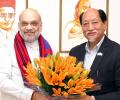
The Nagaland cabinet has decided to meet both the NSCN-IM and the Government of India to push for a resolution to the Naga political dialogue. This comes after the NSCN-IM threatened to return to the jungles due to delays in the resolution, and demanded third-party intervention. The Nagaland cabinet will meet with Union Home Minister Amit Shah in Delhi to press for expediting the negotiations. The NSCN-IM has accused the Centre of refusing to honour key provisions of the Framework Agreement, specifically the recognition of the "Naga national flag and constitution." The state cabinet is also scheduled to meet with the NSCN-IM leadership before their trip to Delhi.

The new interlocutor, AK Mishra, held talks with NSCN-IM chief negotiator Thuingaleng Muivah at Dimapur in Nagaland.

The leadership of the NSCN-K is scheduled to join the peace negotiations in March as part of the Naga National Political Group with Government of India's Interlocutor R N Ravi, reports Sujit Kumar Chakraborty.
The NSCN-IM, which resumed talks to find a solution to the decades-old Naga political issue after a gap of almost two years, said in a statement on Friday that the problem is "deeply rooted in India's malicious pleasure, violating the historical and political rights of the Naga people".
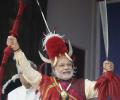
'If the NSCN-IM is cold shoulderd, the chances are that it will slip back into insurgency,' caution Sandeep Pandey, Meera Sanghamitra and Babloo Loitongbam.

'We are not secessionists, we want to coexist with our countrymen but not on the terms that will strip us off our dignity and a right to peaceful existence.'
The parties agreed to the demand of tribal bodies and civil society groups to resolve the Naga political problem first.

'In the first meeting of this new year, we took a joint new year resolution that we will complete it this year. At the time things were not very clear, but the mood was clear that yes, we must resolve it.' 'Yes, details have to come out, but there are some sensitivities, there are some stake-holders not yet on board, especially other Naga undergrounds etc, we would like them to come on board... So at a proper time it has to be revealed to the country, and to the legislature. Perhaps, we may have to wait for some more time.' 'With better understanding of the Indian system, many of them have learnt, realised, appreciated that Naga nationalist aspirations can be accommodated in the Indian system. The Indian system is pretty comprehensive and flexible.' 'A Naga has as much stake, claim over India as any other Indian. There is no distinction. This, Nagas have realised, that yes, Naga nationalist aspirations and Indian nationalism are not mutually exclusive.' Ravindra Narayan Ravi, the Government of India's Special Interlocutor for the Naga talks, explains how the Naga Peace Accord was reached in an exclusive interview to Saisuresh Sivaswamy/Rediff.com

Former West Bengal governor Jagdeep Dhankhar's subsequent elevation set a new benchmark for the actions of those who occupy Raj Bhavans, observes Aditi Phadnis.
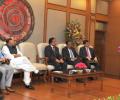
To expect that these past decades of grief, inter-group killings, anxiety and fear will be brushed aside because of the Naga peace accord is being unrealistic. Memories are built on old wounds and they heal slowly. So, it is important to be cautiously optimistic, says Sanjoy Hazarika.

'The visit of the honourable PM with the workable strategy towards conflict resolution will help greatly.' 'But visiting the state without concrete proposals may not bring the desired outcome at this stage.'

Forty MLAs from violence-hit Manipur have written to Prime Minister Narendra Modi stating that the state requires complete disarmament to foster an environment of peace and security.

'In a complex situation a PM coming was not necessary'

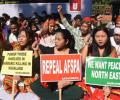
Besides law and order, the long standing demand for junking Armed Forces (Special Powers) Act, economic woes of the land-locked state which has hardly any industries, are expected to figure high on the agenda of the unfolding electoral battle between the two main parties with smaller local parties such as National People's Party and the Naga People's Front chipping in with their own demands.

The SC said at most it can give directions to the authorities to make the situation better and for that it needs assistance of different groups and positive suggestions.

'Had it not been for the complicity of the state and Biren Singh's leadership, these riots would not have spread this far and for so long.'

'Earlier, a lot of fear was in the minds of people that the BJP is anti-Christian and anti-minority, but over the years people have learnt to accept that the BJP is just another national party.'

The church bells don't toll in Churachandpur any more. The hill district in Manipur has been in mourning for more than a year.

'If you put colour-coded internal security maps of India in May 2014 and now, the picture won't be flattering to Modi.' 'Failures on internal security are now piling up and can break Modi's momentum,' says Shekhar Gupta.

In an exclusive interview with rediff at his New Delhi residence this week, former Union Home Secretary G K Pillai categorically stated, "Smaller states have the advantage of effective administration as well as speedy development."
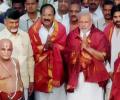
Modi's NDA is good enough to give a psychological boost to the once 'untouchable' BJP and Modi but if the NDA doesn't get a majority on its own, then walking the last mile will be the greatest challenge of this election for Modi, says Sheela Bhatt/Rediff.com

State after state has imposed an alcohol ban, and has had to retreat, unable to address the financial and administrative fallout. Are we set for more of this cycle, asks Aditi Phadnis.
 © 2026 Rediff.com - Advertise with us - Disclaimer - Privacy Policy - Sitemap - Feedback - About us - Terms of use - Grievances